
As low-altitude airspace becomes increasingly complex and unmanned aircraft systems (UAS) continue to proliferate, the demand for intelligent, integrated security solutions across modern critical infrastructure is growing rapidly.
CloudWing Defense is a technology-driven company specializing in the research, development, and deployment of comprehensive multi-domain security systems. The company is committed to building an AIoT-based intelligent security architecture covering low-altitude airspace security, perimeter protection, and high-value asset defense.
Powered by its proprietary AIoT Cloud Platform + Edge Computing architecture, CloudWing Defense integrates RF sensing, electro-optical technologies, computer vision, and positioning technologies to deliver end-to-end situational awareness and automated response capabilities.
Integrated Counter-Drone System: A Unified Defense Architecture
Modern drone threats can no longer be addressed by standalone devices. CloudWing Defense has developed a comprehensive Integrated Counter-Unmanned Aircraft System (C-UAS) that unifies detection, identification, tracking, decision-making, and mitigation within a single coordinated platform.
The Integrated Counter-Drone System includes:
• RF Modules for drone signal interception and protocol analysis.
• Phased Array Radar Systems for long-range, high-precision airspace detection and target tracking.
• Electro-Optical and AI Vision Systems for target recognition, identification, and classification.
• AI Fusion Engine for real-time threat assessment and coordinated response.
By combining multiple sensing and intelligent technologies, the system establishes a complete operational workflow:
Detect → Identify → Track → Assess → Mitigate
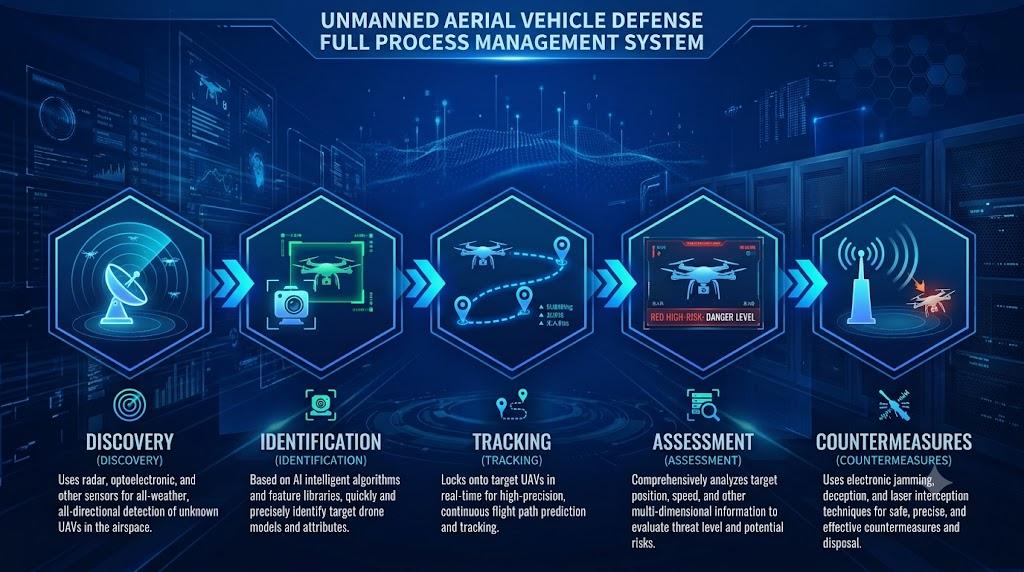
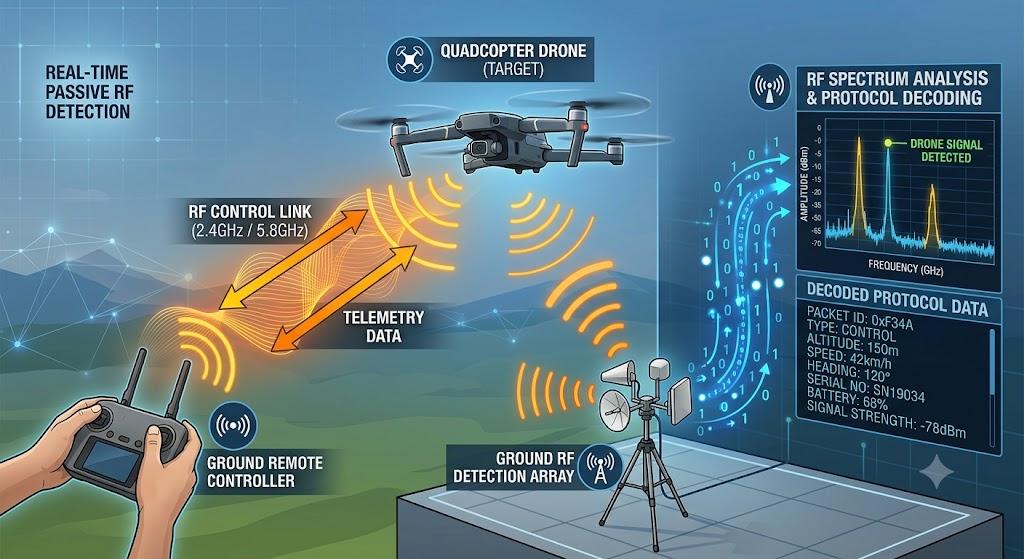
RF Module Technology: The First Layer of Airspace Awareness
Radio Frequency (RF) modules serve as the frontline sensing capability of modern counter-drone systems, enabling the detection and analysis of communication signals exchanged between unmanned aircraft and their ground control stations.
CloudWing Defense’s RF sensing technology provides the following capabilities:
• Passive detection of drone command-and-control (C2) and video transmission signals.
• Protocol analysis and RF signal fingerprint identification for drone recognition.
• Real-time spectrum analysis in complex electromagnetic environments.
• Simultaneous monitoring and tracking of multiple aerial targets.
By establishing an intelligent RF intelligence layer, the system significantly enhances early-warning capabilities and improves situational awareness in challenging operational environments.
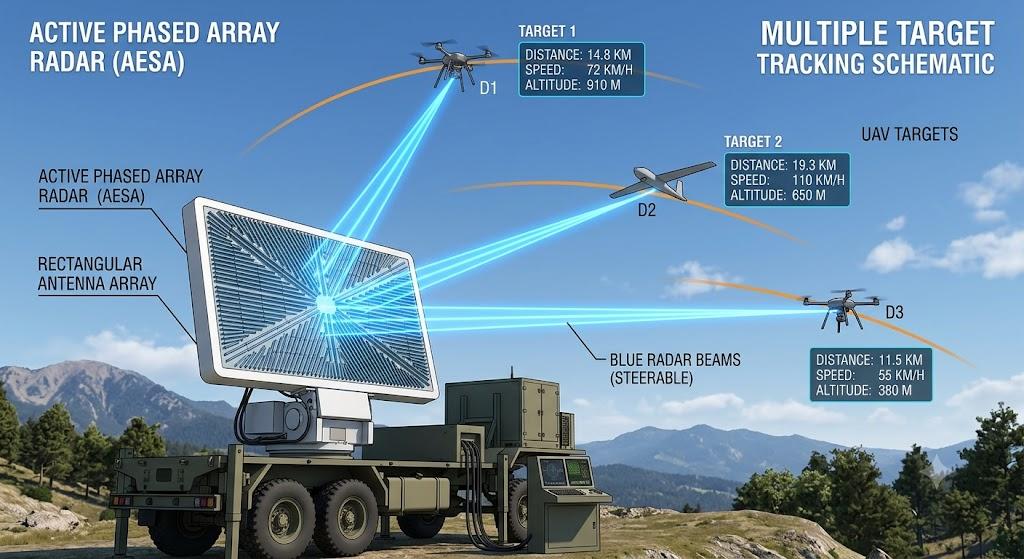
Phased Array Radar: The Core of High-Precision Tracking in Complex Airspace
To strengthen airspace surveillance capabilities, CloudWing Defense integrates advanced Phased Array Radar technology for high-precision, multi-target detection and tracking.
Key advantages include:
• Electronic beam steering for rapid and comprehensive airspace scanning.
• Real-time multi-target tracking with high positional accuracy.
• Superior resistance to electromagnetic interference (EMI) in challenging operational environments.
• Reliable all-weather, 24/7 operation for continuous mission readiness.
Working in coordination with RF sensing and electro-optical systems, the phased array radar significantly enhances overall detection, tracking, and target identification performance, providing a more comprehensive and reliable airspace surveillance capability.
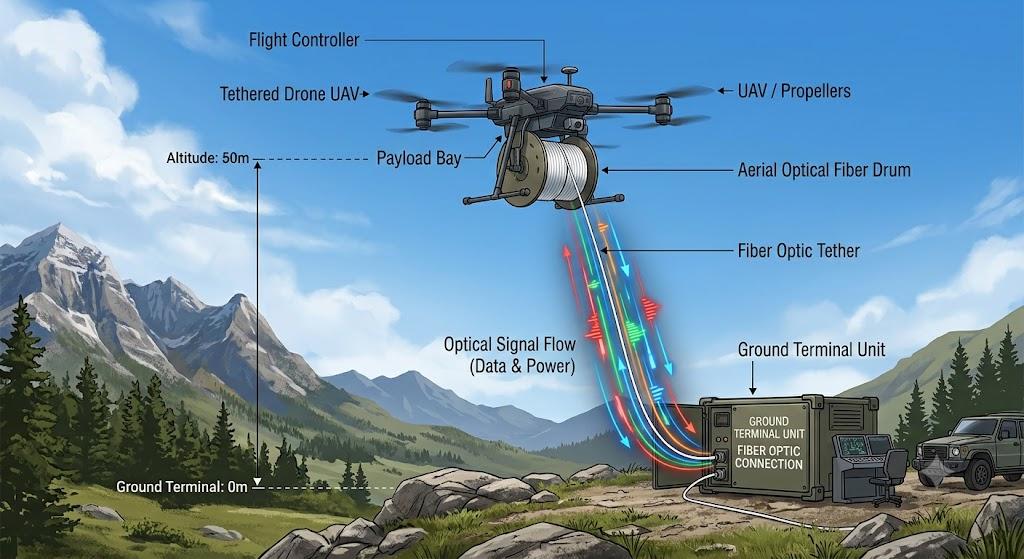
Fiber-Optic Drones and Fiber-Optic Spool Systems
In recent years, a new generation of unmanned aircraft technology—fiber-optic drones—has emerged for deployment in highly contested operational environments.
Unlike conventional UAVs that rely on wireless communication links, these systems utilize a fiber-optic spool system to maintain a physical fiber-optic connection between the drone and the ground control station, enabling secure and uninterrupted data transmission.
For defense and specialized mission applications, fiber-optic drone systems offer several key advantages:
• Exceptional resistance to electronic jamming and signal interference.
• Highly reliable and stable command-and-control (C2) communications.
• High-bandwidth, real-time video and data transmission.
• Stable operation in GPS-denied or electronically contested environments.
CloudWing Defense is actively exploring the application of fiber-optic drone technologies in high-reliability reconnaissance, intelligence gathering, and other specialized mission scenarios where resilient communications and operational continuity are critical.
Integrated Counter-Drone Platform: Unified Command and Response
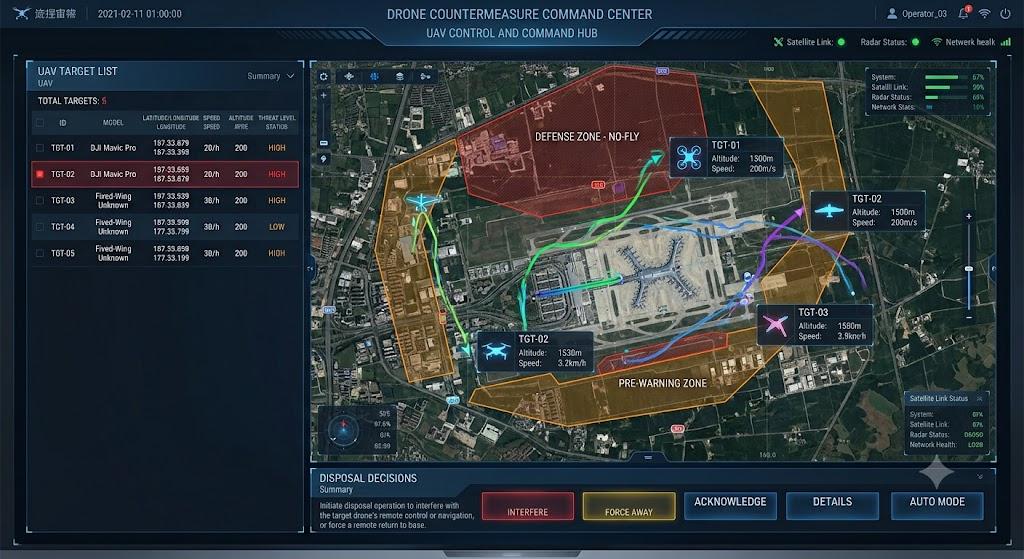
CloudWing Defense has developed an integrated Counter-Unmanned Aircraft System (C-UAS) platform that unifies sensing, analysis, command, and mitigation into a single intelligent solution.
Its core capabilities include:
• Automatic drone detection, identification, and classification.
• Real-time localization and trajectory prediction.
• AI-powered threat assessment and automated decision support.
• Coordinated response across multiple sensing and defense systems.
• Centralized Command and Control (C2) platform for unified operational management.
The platform is designed for deployment across a wide range of high-security environments, including:
• Airports and aviation infrastructure.
• Energy and power facilities.
• Government agencies and public security organizations.
• Large-scale public events and critical venues.
• Transportation hubs and border security checkpoints.
AIoT-Powered Multi-Domain Intelligent Security Ecosystem
Leveraging its proprietary AIoT Cloud Platform and Edge Computing architecture, CloudWing Defense delivers intelligent, scalable security solutions across multiple operational domains.
Key application areas include:
• Low-altitude airspace management systems.
• Perimeter intrusion detection and protection systems.
• Critical infrastructure security.
• Smart city security platforms.
• Emergency command and coordinated response systems.
Through multi-source data fusion, edge intelligence, and AI-driven analytics, the platform significantly enhances situational awareness, accelerates threat detection, and improves overall operational response efficiency across complex security environments.
Conclusion
As the adoption of unmanned aircraft systems (UAS) continues to accelerate worldwide, the demand for advanced counter-drone technologies and integrated security solutions is growing across both public and private sectors.
CloudWing Defense is building a comprehensive counter-drone ecosystem by integrating RF sensing, phased array radar, fiber-optic drone technologies, and AI-driven intelligence into a unified defense architecture. Through continuous technological innovation and multi-sensor data fusion, the company delivers enhanced situational awareness, intelligent threat assessment, and coordinated response capabilities for complex operational environments.
Built upon its All-in-One Counter-Drone System architecture, CloudWing Defense provides scalable, intelligent, and reliable solutions for protecting low-altitude airspace, critical infrastructure, and high-value assets. As security challenges continue to evolve, the company remains committed to advancing next-generation technologies that strengthen resilience, improve operational efficiency, and support the future of integrated security.
Peter Chan