

Regional bank Cathay General Bancorp (NASDAQ:CATY) announced better-than-expected revenue in Q3 2026, with sales up 22.8% year on year to $254.6 million. Its GAAP profit of $1.43 per share was 1.6% below analysts’ consensus estimates.
Is now the time to buy Cathay General Bancorp? Find out by accessing our full research report, it’s free.
Cathay General Bancorp (CATY) Q3 2026 highlights:
- Net Interest Income: $211.9 million vs analyst estimates of $207.2 million (11.8% year-on-year growth, 2.2% beat)
- Net Interest Margin: 3.5% vs analyst estimates of 3.5% (4.8 basis point beat)
- Revenue: $254.6 million vs analyst estimates of $227.4 million (22.8% year-on-year growth, 12% beat)
- Efficiency Ratio: 40.6% vs analyst estimates of 39.7% (88 basis point miss)
- EPS (GAAP): $1.43 vs analyst expectations of $1.45 (1.6% miss)
- Tangible Book Value per Share: $40.54 vs analyst estimates of $40.86 (9.7% year-on-year growth, 0.8% miss)
- Market Capitalization: $4.05 billion
“Our third quarter results reflected strong performance across the franchise. Net interest income grew, loans and deposits increased meaningfully, and net interest margin continued to expand,” said Chang M. Liu, President and Chief Executive Officer of the Company. “We remain focused on disciplined execution and prudent balance sheet management to build on this progress and continue delivering long-term value for our shareholders.”
Company overview
Founded in 1962 with its first branch in Los Angeles' Chinatown, Cathay General Bancorp (NASDAQ:CATY) operates Cathay Bank, providing commercial banking services to businesses and individuals with a strong presence in Asian-American communities.
Sales growth
In general, banks make money from two primary sources. The first is net interest income, which is interest earned on loans, mortgages, and investments in securities minus interest paid out on deposits. The second source is non-interest income, which can come from bank account, credit card, wealth management, investment banking, and trading fees. Unfortunately, Cathay General Bancorp’s 7.5% annualized revenue growth over the last five years was tepid. This was below our standard for the banking sector and is a rough starting point for our analysis.
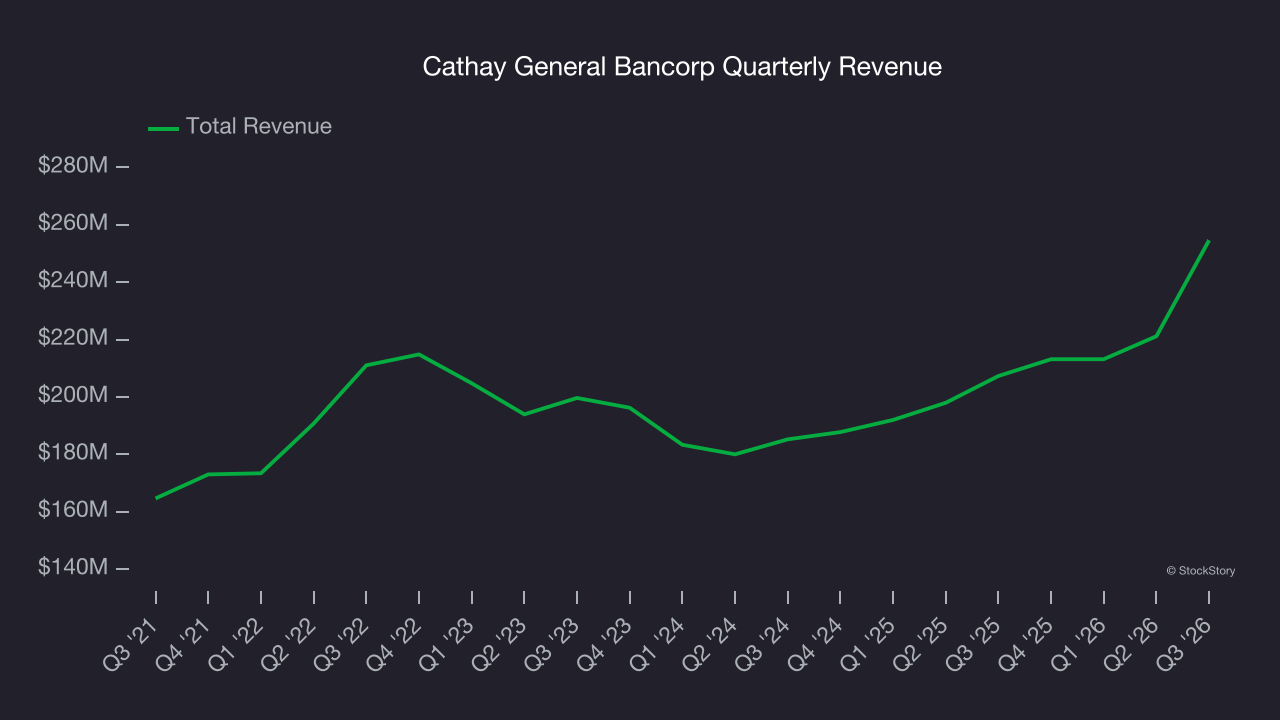
We at StockStory place the most emphasis on long-term growth, but within financials, a half-decade historical view may miss recent interest rate changes, market returns, and industry trends. Cathay General Bancorp’s annualized revenue growth of 10% over the last two years is above its five-year trend, suggesting some bright spots. 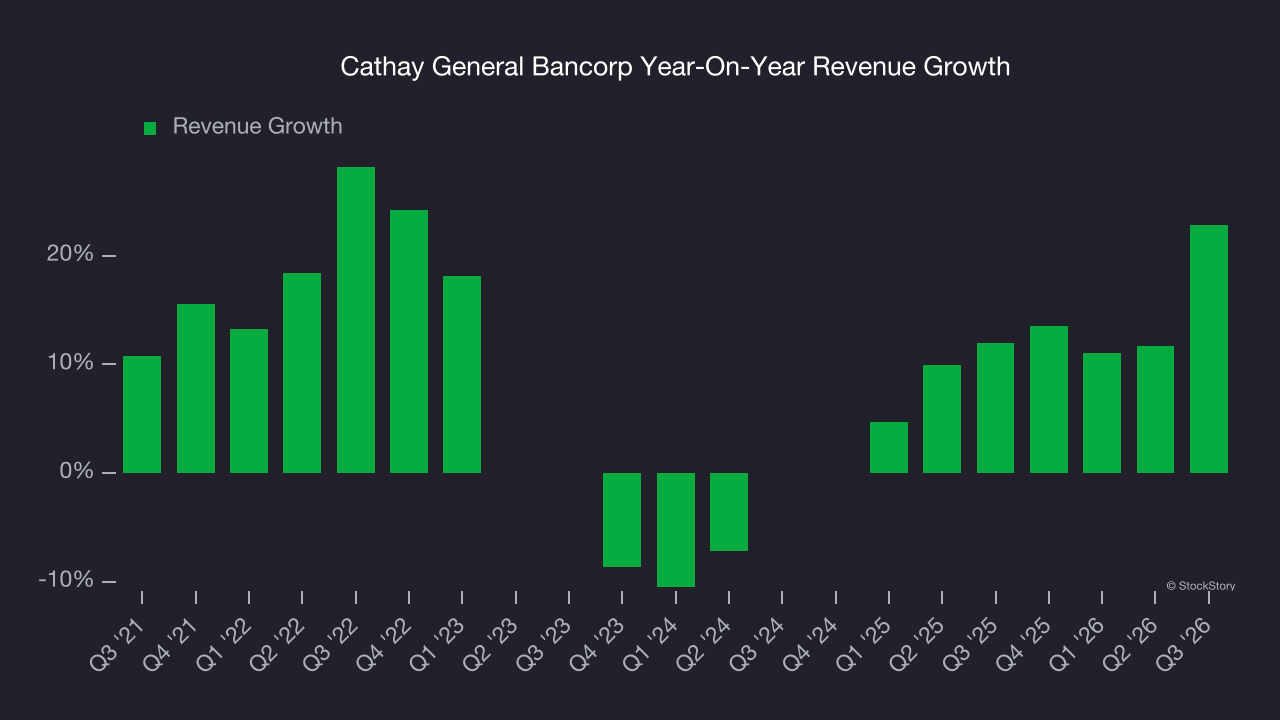 Note: Quarters not shown were determined to be outliers because they were impacted by outsized investment gains/losses that are not indicative of the recurring fundamentals of the business.
This quarter, Cathay General Bancorp reported robust year-on-year revenue growth of 22.8%, and its $254.6 million of revenue topped Wall Street estimates by 12%.
Net interest income made up 91.6% of the company’s total revenue during the last five years, meaning Cathay General Bancorp lives and dies by its lending activities because non-interest income barely moves the needle.
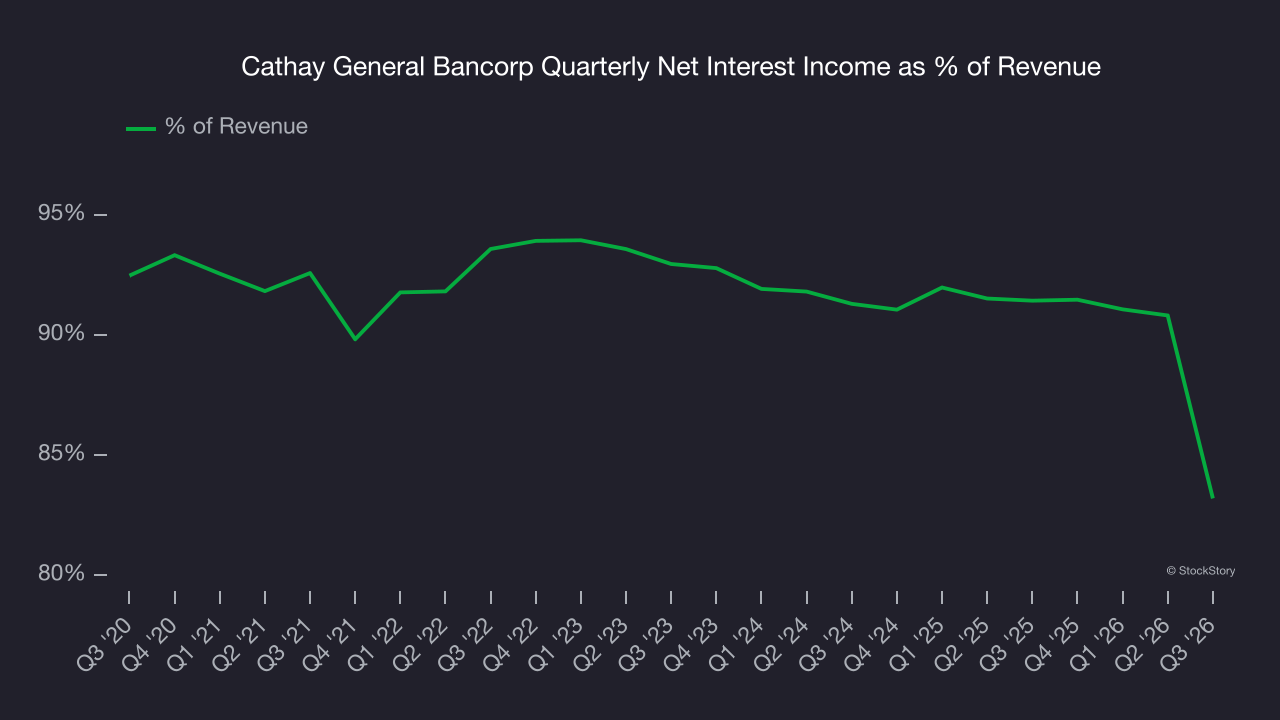
Net interest income commands greater market attention due to its reliability and consistency, whereas non-interest income is often seen as lower-quality revenue that lacks the same dependable characteristics.
WHILE YOU’RE HERE: The Next Palantir? One satellite company captures images of every point on Earth. Every single day. The Pentagon wants it. Hedge funds are using it to beat earnings. You’ve probably never heard of it.
This is what the early days of Palantir looked like before it became a giant. Same playbook. Different technology. If you missed Palantir, you need to see this. Claim The Stock Ticker for Free HERE.
Tangible book value per share (TBVPS)
Banks are balance sheet-driven businesses because they generate earnings primarily through borrowing and lending. They’re also valued based on their balance sheet strength and ability to compound book value (another name for shareholders’ equity) over time.
This is why we consider tangible book value per share (TBVPS) the most important metric to track for banks. TBVPS represents the real, liquid net worth per share of a bank, excluding intangible assets that have debatable value upon liquidation. On the other hand, EPS is often distorted by mergers and flexible loan loss accounting. TBVPS provides clearer performance insights.
Cathay General Bancorp’s TBVPS grew at an excellent 8.5% annual clip over the last five years. The last two years show a similar trajectory as TBVPS grew by 8.6% annually from $34.35 to $40.54 per share.
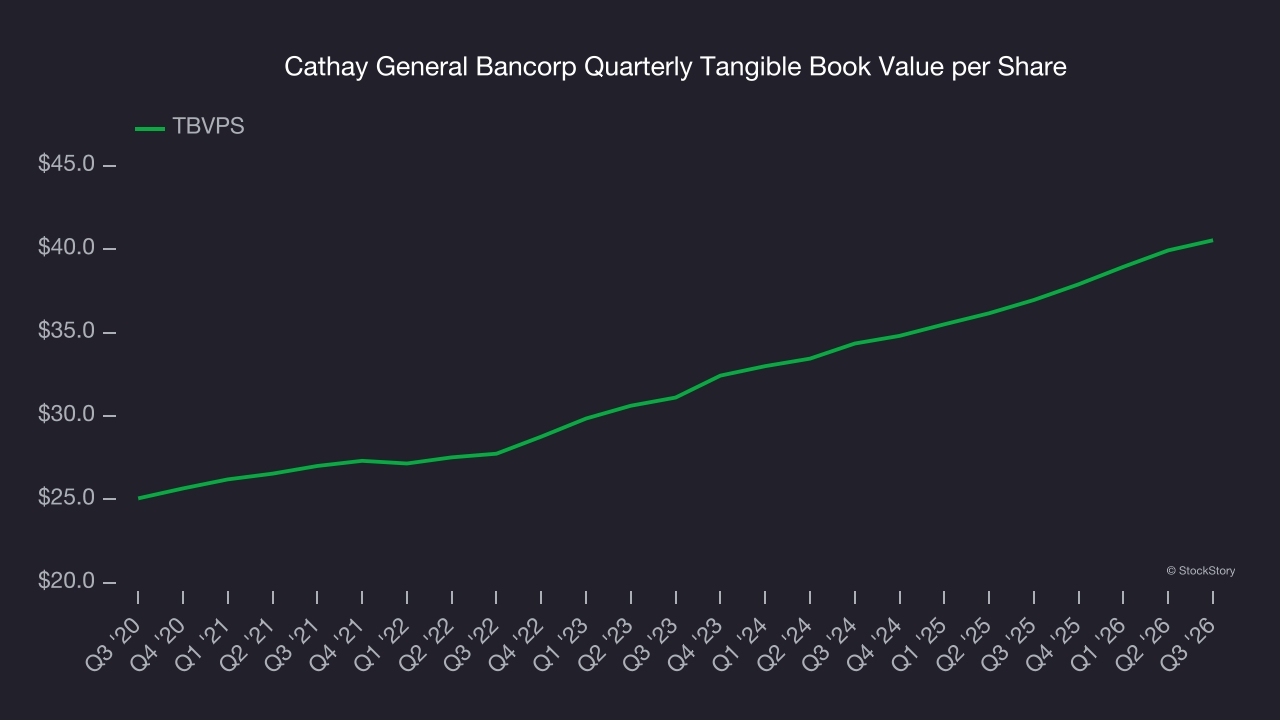
Over the next 12 months, Consensus estimates call for Cathay General Bancorp’s TBVPS to grow by 10.5% to $44.80, mediocre growth rate.
Key takeaways from Cathay General Bancorp’s Q3 results
We were impressed by how significantly Cathay General Bancorp blew past analysts’ revenue expectations this quarter. We were also happy its net interest income outperformed Wall Street’s estimates. On the other hand, its EPS missed and its tangible book value per share fell slightly short of Wall Street’s estimates. Overall, this print was mixed but still had some key positives. Investors were likely hoping for more, and shares traded down 2.6% to $59.06 immediately after reporting.
So do we think Cathay General Bancorp is an attractive buy at the current price? We think that the latest quarter is only one piece of the longer-term business quality puzzle. Quality, when combined with valuation, can help determine if the stock is a buy. We cover that in our actionable full research report which you can read here (it’s free).